

In the modern digital ecosystem, a landing page is not merely a web address; it is a strategic conversion engine. Data shows that the average landing page converts at just 2.35%, meaning that 97.65% of your traffic is leaving without taking action. This statistic highlights the critical importance of structural integrity and psychological triggers in web design. For businesses aiming to maximize return on ad spend, understanding the anatomy of a high-performing page is non-negotiable. We find the balance of data and creative to accelerate growth, ensuring that every pixel serves a purpose in guiding the user toward a decision.
Defining the Landing Page
Before diving into the mechanics, we must establish a clear baseline. A landing page is a standalone web page created specifically for a marketing or advertising campaign. It is where a visitor "lands" after they click on a link in an email, or ads from Google, Bing, YouTube, Facebook, Instagram, Twitter, or similar places on the web. Unlike a website homepage, which has many goals and encourages exploration, a landing page has a single focus or goal, known as a call to action (CTA).
This singular focus is what makes landing pages so powerful for lead generation and sales. By removing navigation bars and other distractions, you force the user to focus on one specific action. This concept is central to our approach at Design Digital, where we specialize in turning traffic into tangible business outcomes through precise digital strategy.
The Hero Section: First Impressions
The hero section is the first thing a visitor sees without scrolling. It must communicate value instantly. If a user cannot understand what you offer within three seconds, they will leave. The hero section typically includes a headline, subheadline, and a primary visual.
The Headline
Your headline is the most important element of your landing page. It should be clear, concise, and benefit-driven. Avoid cleverness in favor of clarity. For example, instead of saying "Welcome to Our World," say "Double Your Sales in 30 Days." This aligns with the performance marketing principles we advocate for in our advertising basics guide.
The Subheadline
The subheadline supports the headline by providing context. It answers the "how" and "why." If the headline grabs attention, the subheadline builds interest. It should elaborate on the promise made in the headline without repeating it verbatim.
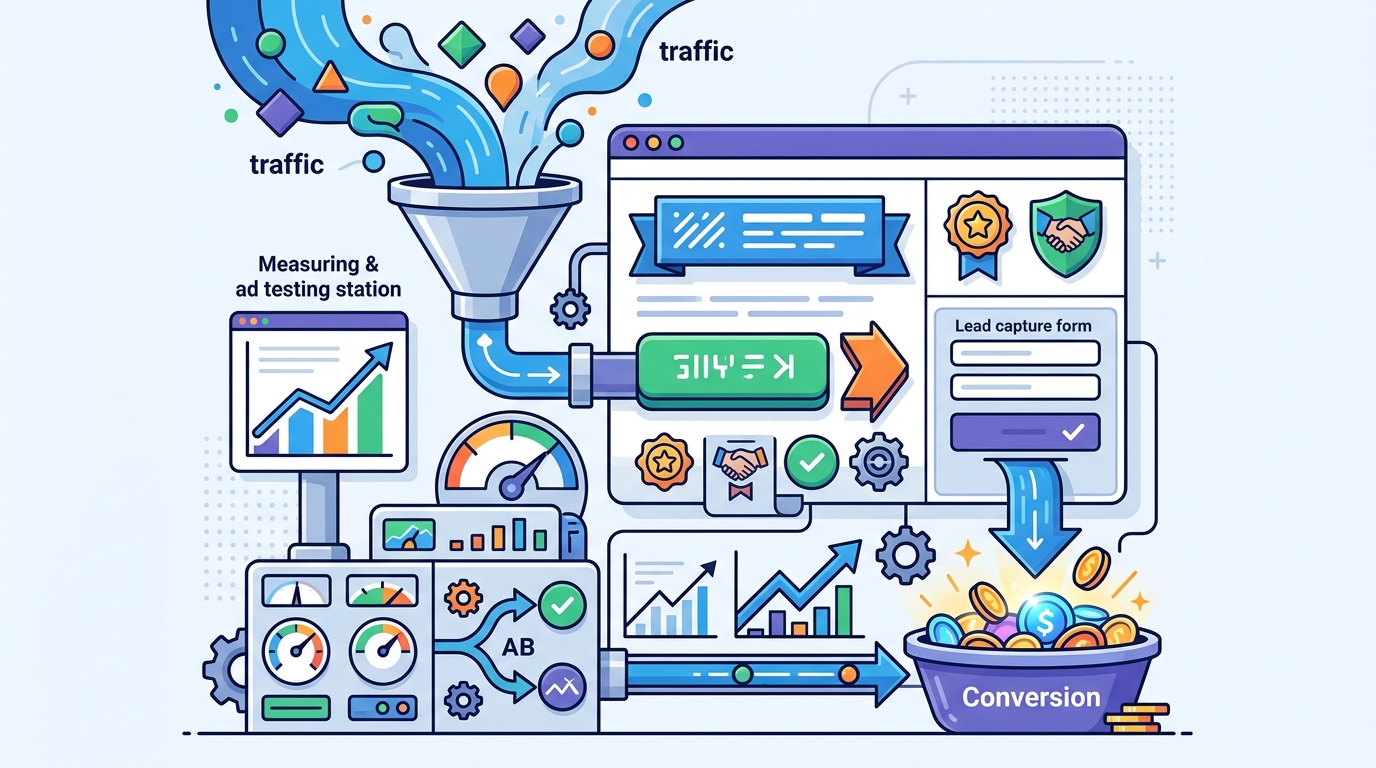
The Visual
Visuals play a crucial role in emotional engagement. High-quality images or videos that depict the product in use or the result of using the service can significantly boost conversion rates. At Design Digital, we ensure that every visual asset is optimized for both speed and impact, balancing data insights with creative excellence.
Copywriting for Conversion
Great design cannot save poor copy. Your landing page copy must address the visitor's pain points and offer a clear solution. This requires a deep understanding of your target audience and their motivations.
Benefits Over Features
Visitors care about what they get, not what you have. Focus on benefits rather than features. For instance, instead of saying "Our software has 256-bit encryption," say "Your data is completely secure from hackers." This shift in perspective helps the visitor visualize the value they will receive.
Clarity and Simplicity
Use simple language that your target audience understands. Avoid jargon and complex sentences. The goal is to make the value proposition obvious. If a visitor has to work hard to understand what you are offering, they will likely leave. This principle is echoed in our blog posts on digital strategy, where we emphasize the importance of clear communication in driving results.
Visual Hierarchy and Media
Visual hierarchy guides the visitor's eye through the page in a specific order. It ensures that the most important elements are seen first. This is achieved through the use of size, color, and placement.
Color and Contrast
Use contrasting colors for your call-to-action buttons to make them stand out. The button color should be distinct from the rest of the page palette. This draws attention and encourages clicks. Research indicates that visual elements can increase comprehension by up to 400%, according to Forbes Agency Council.
Whitespace
Whitespace, or negative space, is the empty space between elements. It helps to reduce cognitive load and makes the content easier to read. Do not be afraid to leave space around your key elements. This breathing room allows the content to stand out and feel more premium.
Social Proof and Credibility
In the absence of physical interaction, trust is the currency of the digital world. Social proof provides evidence that others have used your product or service and found it valuable. This reduces the perceived risk for new visitors.
Testimonials
Include testimonials from satisfied customers. Real names, photos, and specific results make testimonials more credible. Generic quotes like "Great service!" are less effective than detailed accounts of how your product helped a specific person.
Logos and Badges
Displaying logos of well-known clients or industry awards can instantly boost credibility. If you have worked with recognizable brands, showcase them prominently. This leverages the authority of those brands to validate your own. Our work with industry leaders like Design Digital demonstrates the power of strategic partnerships in building brand trust.
Form Optimization
Forms are the primary mechanism for capturing leads. However, they are also the biggest barrier to conversion. The fewer fields you ask for, the higher your conversion rate will be. Every additional field can reduce conversions by up to 10%, according to Unbounce.
Minimize Fields
Only ask for information that is absolutely necessary. If you need more details later, you can collect them in subsequent steps. Consider using progressive profiling to gather information over time rather than all at once.
Clear Call to Action
Your CTA button text should be action-oriented and specific. Avoid generic phrases like "Submit." Instead, use text that describes the benefit, such as "Get My Free Quote" or "Download the Guide." This sets clear expectations for what happens next.
Landing Page vs. Homepage
Understanding the difference between a landing page and a homepage is crucial for effective marketing. A homepage is designed for brand awareness and general information, while a landing page is designed for conversion.
| Feature | Landing Page | Homepage |
|---|---|---|
| Primary Goal | Single conversion action | Brand exploration |
| Navigation | Minimal or none | Full site navigation |
| Content Focus | Specific offer or product | Overview of services |
| Target Audience | Warm leads from ads | General traffic |
| Call to Action | One primary CTA | Multiple CTAs |
Using the right page for the right campaign ensures that your marketing efforts are not diluted. For more insights on digital strategy, explore our digital strategy services.
Key Takeaways
- Singular Focus: Every element on the page should support one primary goal.
- Clear Headline: Communicate value within the first three seconds.
- Visual Hierarchy: Guide the eye with size, color, and whitespace.
- Social Proof: Build trust with testimonials and client logos.
- Minimal Forms: Reduce friction by asking for only essential information.
- Action-Oriented CTAs: Use specific, benefit-driven button text.
- Data-Driven Optimization: Continuously test and refine based on performance metrics.
Frequently Asked Questions
What is the ideal length for a landing page?
There is no one-size-fits-all answer. Long-form pages can work well for complex offers that require education, while short pages can be effective for simple, low-commitment actions. The key is to provide enough information to overcome objections without overwhelming the visitor.
How many calls to action should a landing page have?
It is best to have only one primary call to action. Multiple CTAs can confuse visitors and reduce conversion rates. Secondary links, such as to a blog or about page, should be minimized or removed entirely.
Why is mobile optimization important for landing pages?
A significant portion of web traffic comes from mobile devices. If your landing page is not responsive or loads slowly on mobile, you will lose a large percentage of your potential customers. Mobile-first design is essential for modern marketing success.
How often should I update my landing pages?
Regular updates are crucial to maintain relevance and performance. Test different elements, such as headlines, images, and CTAs, to see what resonates best with your audience. A/B testing is a powerful tool for continuous improvement.
What is the difference between a lead generation page and a click-through page?
A lead generation page captures visitor information directly on the page using a form. A click-through page sends the visitor to another page, typically a checkout or registration page, to complete the conversion. The choice depends on your sales process and the complexity of your offer.
Can I use the same landing page for multiple campaigns?
While it is possible, it is generally more effective to create specific landing pages for each campaign. This allows you to tailor the message to the specific audience and source of the traffic, improving relevance and conversion rates.
How do I measure the success of a landing page?
Key metrics include conversion rate, bounce rate, average time on page, and cost per acquisition. Use analytics tools to track these metrics and identify areas for improvement. Regular analysis helps you understand what is working and what needs adjustment.
Start Optimizing Today
Building a high-converting landing page is not a one-time task but an ongoing process of refinement and optimization. By focusing on the essential elements outlined in this guide, you can create pages that not only attract visitors but also turn them into customers. If you need expert assistance in designing and implementing these strategies, contact Design Digital today. We bring strategists, creative storytellers, and digital specialists under one roof to help you achieve your growth goals.