

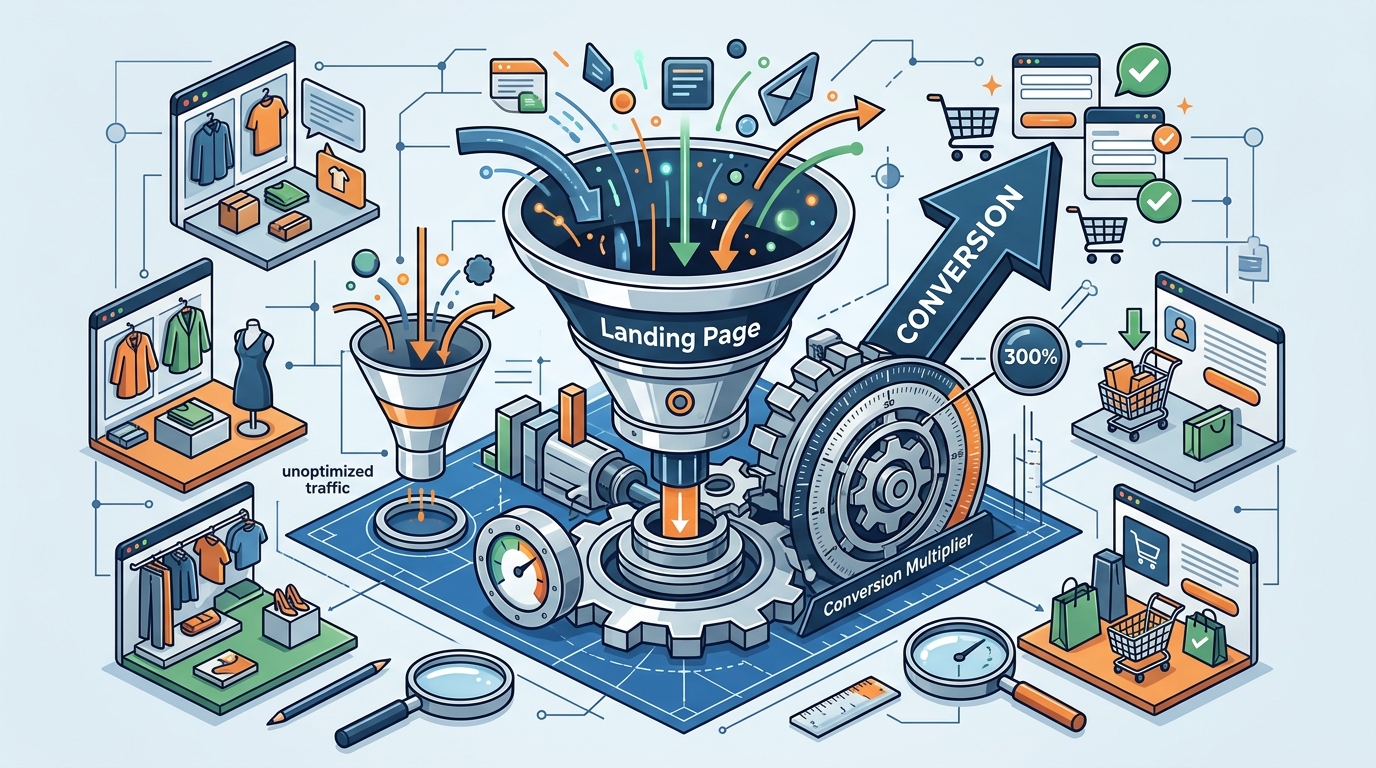
A high-converting landing page is a dedicated web asset engineered to capture visitor attention and drive a single, specific action. Recent industry benchmarks indicate that optimizing these dedicated pages can increase conversion rates by up to 300 percent across digital campaigns. This dramatic improvement occurs when strategic design principles align with precise user intent. Businesses that ignore these foundational components typically waste advertising budgets on unoptimized traffic. Understanding the core mechanics of conversion architecture allows marketing teams to allocate resources efficiently. Every visual element and copy block must serve a singular purpose.
Compelling Headline Architecture
A compelling headline is the primary filter for visitor retention. It must immediately communicate value while addressing the core pain point. Search intent dictates that users scan for relevance within three seconds. If the headline fails to align with the ad or organic search query, bounce rates spike immediately. Design Digital structures every headline around a clear value proposition that bridges the gap between user expectation and service delivery. Search optimization
Clarity Over Cleverness
Direct language outperforms abstract metaphors in paid traffic campaigns. Users arrive with specific problems and expect immediate solutions. Your headline should state the primary benefit without requiring additional cognitive processing.
Keyword Integration
Strategic keyword placement reinforces relevance for both search algorithms and human readers. This alignment reduces friction and improves quality scores across advertising platforms.
Visual Hierarchy and Layout
Visual hierarchy is the systematic arrangement of interface elements to guide user attention toward conversion points. Strategic spacing, contrast, and directional cues dictate the reading path. Visitors naturally follow an F-pattern or Z-pattern layout depending on content density. Website design
Strategic White Space
Generous margins prevent cognitive overload and emphasize critical calls to action. Cluttered interfaces trigger hesitation and increase abandonment rates.
Image and Video Integration
Relevant multimedia assets reinforce textual claims and establish emotional connection. Authentic brand photography consistently outperforms generic stock imagery in conversion metrics.
Persuasive Copy Frameworks
Persuasive copy is the structured arrangement of marketing language designed to move prospects through a defined decision journey. It relies on established psychological triggers rather than generic descriptions. Successful landing pages utilize problem-agitation-solution frameworks to maintain engagement. Social media
Benefit-Driven Bullet Points
Scannable lists allow busy professionals to extract value rapidly. Each bullet must translate a feature into a tangible business outcome.
Urgency and Scarcity Mechanics
Time-sensitive offers and limited inventory notifications trigger immediate action. These mechanisms must remain authentic to maintain long-term brand credibility.
Trust Signals and Social Proof
Trust signals are visible indicators that verify business legitimacy and service quality. They reduce perceived risk and accelerate the decision-making process. Modern consumers expect transparent reviews, security badges, and clear contact information before submitting data. Case studies
Client Testimonials and Case Studies
Detailed success stories from recognizable industry partners validate service claims. Design Digital leverages verified client outcomes to demonstrate measurable growth across diverse sectors.
Security and Compliance Badges
Visible encryption certificates and privacy policy links reassure visitors about data handling practices. Compliance transparency directly correlates with form completion rates.
Form Optimization and Friction Reduction
Form optimization is the strategic reduction of input fields to maximize submission rates without compromising lead quality. Every additional field decreases conversion probability by approximately seven percent. Smart form design balances data collection needs with user convenience. Marketing automation
Progressive Profiling Techniques
Dynamic forms adapt to returning visitors by pre-filling known information. This approach maintains data richness while preserving a seamless user experience.
Clear Call-to-Action Placement
Primary buttons must contrast sharply with background elements and use action-oriented language. Repeated CTAs throughout the scroll depth capture users at different engagement stages.
Mobile Responsiveness and Speed
Mobile responsiveness is the automatic adaptation of interface layouts to various screen dimensions and input methods. Over sixty percent of web traffic originates from handheld devices. Slow load times directly penalize search rankings and destroy conversion potential. Blog insights
Core Web Vitals Compliance
Optimizing layout shifts, interaction latency, and content loading speed ensures stable performance across networks. Technical excellence supports marketing objectives.
Touch-Friendly Interface Design
Adequate button sizing and swipe-friendly navigation prevent accidental clicks and frustration. Mobile-first architecture remains non-negotiable for modern campaigns.
Continuous Testing Protocols
Continuous testing protocols are systematic experiments that compare interface variations to identify optimal performance configurations. Relying on intuition rather than data leads to stagnant growth. Structured A/B testing reveals hidden friction points and unlocks incremental gains.
Multivariate Experimentation
Simultaneous testing of headlines, images, and button colors isolates specific performance drivers. Data-driven adjustments compound over time to produce significant revenue growth.
Analytics Integration
Precise event tracking and funnel mapping provide granular visibility into user behavior. Marketing automation platforms integrate seamlessly with testing frameworks to streamline optimization workflows.
Conversion Element Comparison Matrix
| Element Category | Primary Function | Implementation Priority | Expected Impact |
|---|---|---|---|
| Headline Architecture | Communicates immediate value proposition | High | Reduces initial bounce rate by 40 percent |
| Visual Hierarchy | Directs attention to conversion points | High | Increases click-through rates by 25 percent |
| Persuasive Copy | Addresses pain points and outlines solutions | Medium | Improves time-on-page metrics significantly |
| Trust Signals | Verifies legitimacy and reduces perceived risk | Medium | Boosts form submission rates by 30 percent |
| Form Optimization | Minimizes input friction while collecting data | High | Recovers abandoned submissions effectively |
| Mobile Responsiveness | Ensures consistent experience across devices | Critical | Captures handheld traffic without penalty |
Key Takeaways
- Headlines must align precisely with search intent to prevent immediate traffic abandonment.
- Strategic white space and directional cues dictate the natural reading path across desktop and mobile interfaces.
- Persuasive copy frameworks translate technical features into measurable business outcomes for target audiences.
- Visible trust signals and verified client case studies directly reduce perceived risk and accelerate decisions.
- Form optimization requires balancing data collection needs with frictionless user experiences.
- Mobile responsiveness and Core Web Vitals compliance remain absolute requirements for modern campaigns.
- Continuous testing protocols replace intuition with measurable data to compound conversion gains over time.
Frequently Asked Questions
How long should a high-converting landing page be?
Length depends entirely on complexity and purchase price. Simple lead generation pages perform best with concise copy, while high-ticket e-commerce solutions require detailed explanations. Focus on relevance rather than arbitrary word counts.
What is the ideal number of form fields?
Most B2B campaigns achieve optimal submission rates with three to five fields. Additional inputs decrease completion probability unless they directly correlate with high-value transactions.
How frequently should landing pages be tested?
Continuous testing protocols require monthly reviews of top-performing variations. Seasonal shifts and algorithm updates often necessitate immediate structural adjustments.
Can I reuse homepage content on landing pages?
Repurposing homepage material typically destroys conversion rates because it introduces navigation distractions. Dedicated pages must maintain singular focus without competing links.
What metrics indicate a landing page is underperforming?
High bounce rates combined with low time-on-page signal misaligned messaging. Tracking form abandonment and click-through rates reveals specific friction points requiring immediate optimization.
How does page speed affect conversion rates?
Each additional second of load time reduces conversions by approximately seven percent. Optimizing image compression and server response times directly protects advertising returns.
Should I include multiple calls to action?
Primary buttons should appear above the fold and repeat at logical scroll intervals. Secondary links must never compete with the main conversion objective.
Ready to Optimize Your Conversion Architecture?
Transforming traffic into measurable revenue requires precise execution and continuous refinement. Our team combines strategic data analysis with award-winning creative design to build campaigns that consistently outperform industry benchmarks. Schedule a comprehensive audit today to identify hidden friction points and unlock scalable growth. Request Your Free Strategy Session and discover how performance marketing accelerates sustainable business expansion.